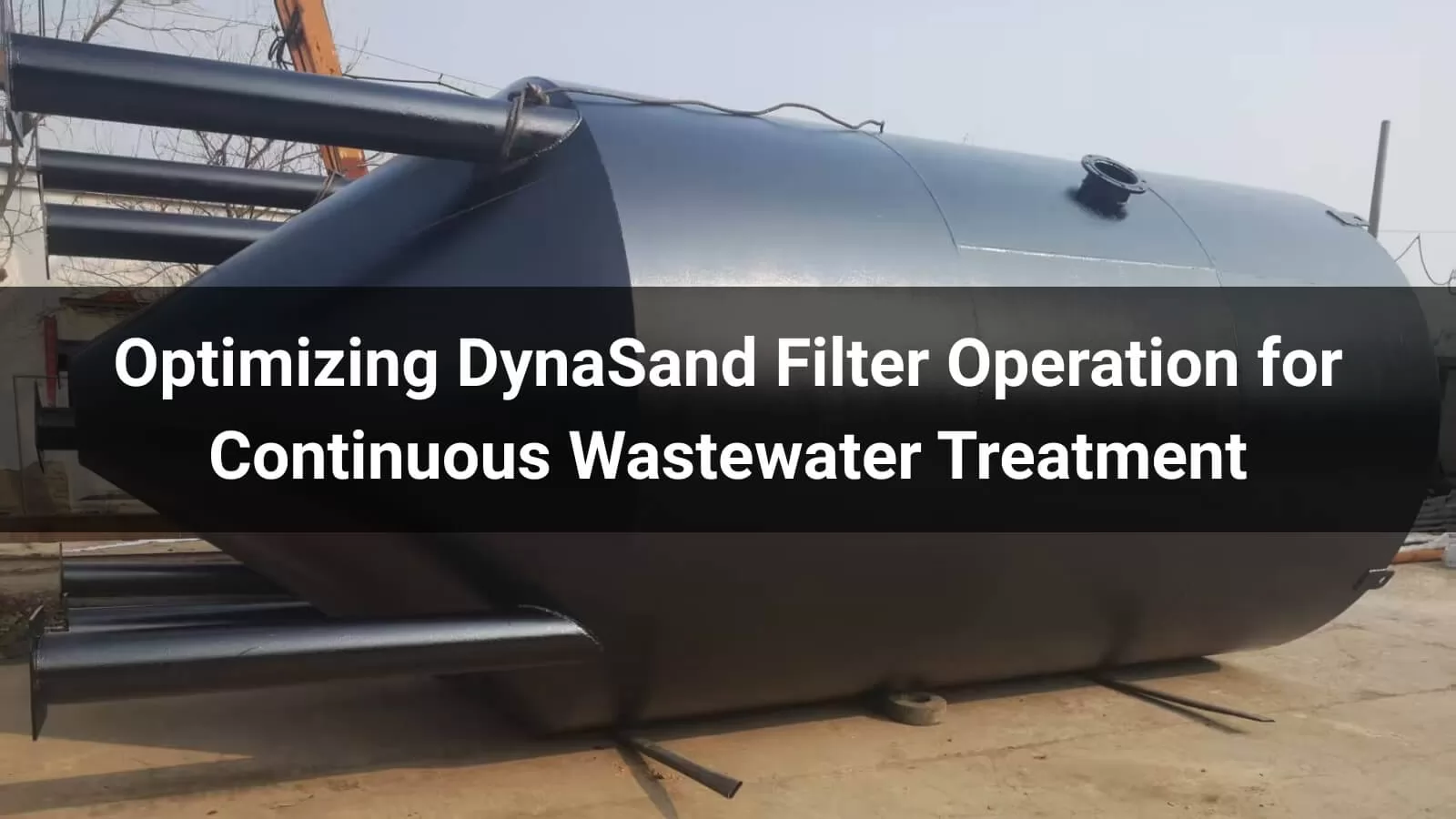
In the world of industrial and municipal water treatment, the efficiency of suspended solids removal determines the overall success of the treatment train. Traditionally, operators have relied on conventional pressure or gravity sand filters. However, these systems come with a significant operational bottleneck: the need to stop filtration for backwashing.
This is where the DynaSand filter operation redefines the standard. Unlike traditional filters that operate in batches, the DynaSand system utilizes a continuous upflow process. By integrating the filtration and sand-washing phases into a single, uninterrupted cycle, it eliminates the need for backwash pumps, storage tanks, and complex automated valving.
Whether you are managing municipal wastewater or high-volume industrial process water, understanding the nuances of DynaSand filter operation is key to reducing your OPEX (Operating Expenses) and maintaining consistent filtrate quality. In this guide, we will break down the mechanics, optimization strategies, and troubleshooting protocols to help you get the most out of your Weilan filtration system.
The brilliance of DynaSand filter operation lies in its "Continuous Upflow" design. Unlike conventional filters that trap particles in a static bed, the DynaSand system treats the filter media as a dynamic, moving entity. Here are the three core principles that drive its performance:
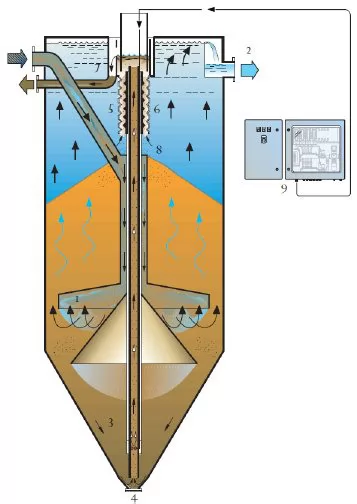
Influent water enters the filter through a feed pipe and is distributed evenly via a series of distributor arms at the base of the sand bed. As the water flows upward, suspended solids are trapped within the downward-moving sand. This counter-current flow ensures that the cleanest water (filtrate) emerges at the top, while the dirtiest sand collects at the bottom.
At the center of the unit is a vertical airlift pump. Small amounts of compressed air are injected at the base of this pump, creating a low-density mixture of air, water, and sand. This mixture rises to the top of the filter. During this turbulent ascent, the vigorous scouring action effectively detaches the trapped organic and inorganic impurities from the sand grains.
Once the sand-water-air mixture reaches the top, it enters the sand washer. Here, the heavier, cleaned sand grains fall back onto the top of the filter bed through a labyrinth-style washer. Simultaneously, a small portion of the filtered water flows upward through the washer, rinsing the sand one last time. The lighter, dirty "reject water" is then discharged over a weir for separate treatment.
By balancing these three principles, the DynaSand filter maintains a constant pressure drop and consistent effluent quality without ever needing to take the unit offline for a backwash cycle.
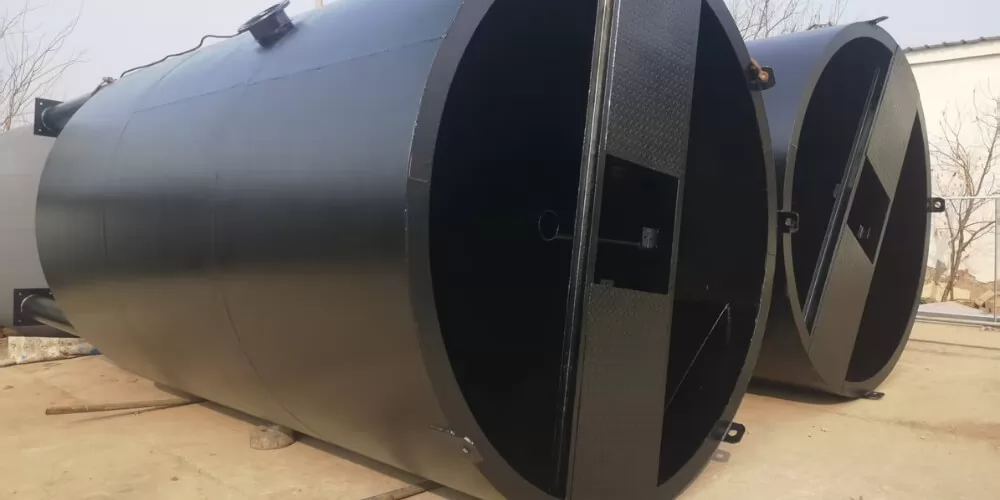
Understanding the step-by-step DynaSand filter operation is essential for maintaining steady-state performance. The process follows a "Counter-Current" model, where water and sand move in opposite directions.
The raw water (influent) enters the filter through an inlet pipe at the top and is directed downward to a set of distribution arms located in the lower section of the filter bed. This ensures that the water is evenly dispersed across the entire surface area of the sand media, preventing "channeling" or localized high-pressure zones.
As the water rises through the downward-moving bed of sand, suspended solids are trapped within the grain interstices. Because the sand is constantly moving, the bottom of the bed—where the water is dirtiest—contains the most "loaded" sand, while the top of the bed provides a final polishing phase with the cleanest sand.
The "dirty" sand at the bottom is continuously drawn into the intake of the central airlift pump. Compressed air is injected at the base, forcing the sand-water-air mixture upward. During this high-velocity ascent, the abrasive action between sand grains scrubs away biological films and inorganic particles.
At the top of the airlift, the mixture enters the Reject Compartment. Here:
The cleaned sand grains fall back onto the top of the filter bed. This ensures that the filtration surface is constantly being renewed with "regenerated" media, allowing the DynaSand filter operation to remain online 24/7 without the need for standby filters or backwash storage tanks.
To maintain the high-efficiency standards of a Weilan system, operators must monitor and adjust several variables. Precise control of these parameters prevents media loss and ensures the highest filtrate quality.
The filtration rate typically ranges between 5 to 12 m/h (m3/m2/h), depending on the influent quality and the specific application (e.g., tertiary wastewater treatment vs. industrial process water).
The airflow is the "engine" of the DynaSand filter operation.
This is the speed at which sand travels from the bottom to the top. A typical turnover rate is roughly 5 to 15 mm/min of downward sand movement.
The reject water flow should generally be 3% to 7% of the total influent flow. This is controlled by adjusting the height of the reject weir.
While DynaSand filters are robust, they perform best when Total Suspended Solids (TSS) in the influent stay below 100 mg/L. For concentrations higher than this, pre-treatment (like coagulation or flocculation) is recommended to optimize the DynaSand filter operation.
| Symptom | Primary Check | Quick Fix |
| Rising Sand Bed Level | Airlift flow | Increase air pressure to boost sand recycling. |
| Falling Sand Bed Level | Reject weir | Lower air pressure; check for sand loss in reject. |
| Erratic Flow | Feed distributor | Check for blockages in the distribution arms. |
One of the primary advantages of DynaSand filter operation is its minimal mechanical complexity. With no moving parts inside the filter bed, maintenance is straightforward. However, a consistent schedule ensures the system operates for decades.
The airlift pump is the "heart" of the system.
While the sand is cleaned continuously, it does experience slight "attrition" (wearing down) over several years.
Over time, depending on the water chemistry, the internal sand washer may accumulate calcium scale or biological slime.
For outdoor installations, ensure that air lines are heat-traced or insulated in freezing climates. During periods of low influent flow (e.g., seasonal plant shutdowns), the air supply can be reduced to "Eco-mode" to save energy while keeping the sand bed fluid.
Mastering DynaSand filter operation is about more than just maintaining a piece of equipment; it is about achieving a level of process stability that traditional filters simply cannot match. By eliminating the mechanical stress and hydraulic surges of backwash cycles, the DynaSand system provides a "steady-state" environment that is ideal for both physical filtration and biological processes (such as denitrification).
As we have explored in this guide, the key to success lies in the delicate balance between influent flux, airlift pressure, and reject water flow. When these parameters are optimized, a Weilan system offers:
For operators and engineers, the DynaSand filter represents the pinnacle of "set-and-forget" technology—provided the initial calibration is handled with precision. Whether you are upgrading an existing plant or designing a new facility, understanding these operational nuances ensures long-term reliability and superior water quality.


Your Name*
Your Email*

Explore Dynasand Filter Technology: design, operation, and performance for efficient water treatment, offering reliability, low energy use, and easy maintenance.

Discover the top 10 water treatment plant EPC contractors in 2025, including global leaders delivering advanced, efficient and sustainable solutions for municipal and industrial water projects.

Discover the top 10 sewage treatment plant manufacturers worldwide and find reliable solutions for efficient, sustainable wastewater management.