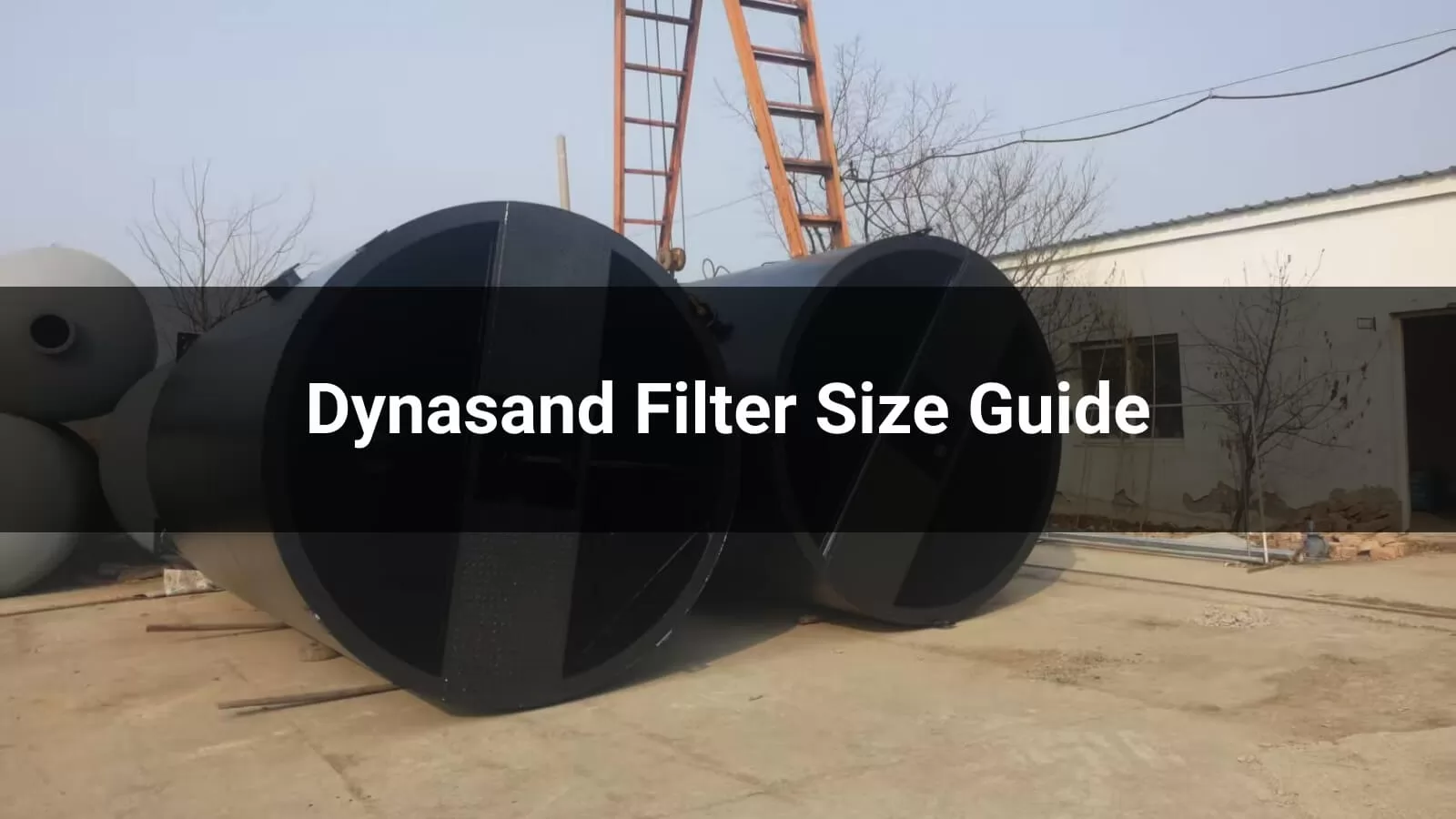
Selecting the right Dynasand filter size is one of the most consequential decisions in any water treatment project. Specify too small, and effluent quality suffers under peak load. Specify too large, and capital is wasted on capacity that will never be used. For project engineers, municipal planners, and industrial facility managers, getting this decision right requires more than a flow rate and a product catalogue.
This guide covers everything you need to make an informed Dynasand filter sizing decision — from understanding how filter area and bed depth interact with hydraulic performance, to comparing model specifications across the full size range, to knowing when a standalone package unit is the right call and when a concrete modular installation makes more sense. Whether you are specifying a filter for a small municipal water supply or a large industrial wastewater reuse system, the frameworks and specifications in this article will give you a reliable foundation for your selection.
Dynasand filters are available across a wide range of sizes to accommodate everything from small municipal installations to large-scale industrial water treatment facilities. Unlike conventional sand filters that require periodic shutdown for backwashing, the continuous upflow design of Dynasand technology means that sizing is primarily driven by hydraulic throughput and filtration quality requirements — not by backwash cycle management.
Filter size is defined by three core parameters:
Filter Area (m² or ft²)
The plan-view footprint of the sand bed, which directly determines hydraulic capacity. Standalone package units typically range from 0.07 m² (DST07) up to approximately 5 m² (DS500), while concrete modular installations can be designed to virtually any total filter area by combining multiple modules in a shared filter cell.
Bed Depth
Two standard configurations are available: a 40-inch (approximately 1,000 mm) standard bed and an 80-inch (approximately 2,000 mm) deep bed. The deep-bed design provides greater hydraulic residence time, supports coagulation and flocculation within the sand bed itself, and is preferred for applications requiring higher effluent quality or where pre-treatment infrastructure is limited.
Configuration Type
Dynasand filters are produced in two primary configurations: standalone package units (cylindrical tanks in 304 SST or FRP) suited for smaller installations and ease of deployment, and concrete modular designs suited for high-capacity systems where multiple modules share a common sand bed and feed header.
Together, these three parameters — filter area, bed depth, and configuration type — define the sizing envelope for any given Dynasand installation and serve as the starting point for engineering selection.
The table below outlines the key specifications for Weilan's Dynasand filter range, covering eight standard standalone models from the WL-05 through to the WL-60:
| Model | Filter Area (m²) | Filter Layer Depth (m) | Flow Rate (m³/h) | Diameter (mm) | Equipment Height (mm) | Wastewater Discharge (%) | Max Air Consumption m³/h (0.4MPa) |
| WL-05 | 0.5 | 1.5–2.0 | 3–5 | 800 | 3,500–4,000 | 5–10 | 2 |
| WL-10 | 1 | 1.5–2.0 | 5–10 | 1,150 | 4,300–4,800 | 5–10 | 2.5 |
| WL-15 | 1.5 | 1.5–2.0 | 10–15 | 1,400 | 4,600–5,100 | 5–10 | 3 |
| WL-20 | 2 | 1.5–2.0 | 15–20 | 1,600 | 5,000–5,500 | 5–10 | 4 |
| WL-30 | 3 | 1.5–2.0 | 20–30 | 2,000 | 5,400–5,900 | 5–10 | 6 |
| WL-40 | 4 | 1.5–2.0 | 30–40 | 2,260 | 5,800–6,300 | 5–10 | 8 |
| WL-55 | 5.5 | 1.5–2.0 | 40–55 | 2,650 | 6,200–6,700 | 5–10 | 10 |
| WL-60 | 6 | 1.5–2.0 | 55–60 | 2,770 | 6,500–7,000 | 5–10 | 12 |
Flow rate is the most critical parameter in Dynasand filter sizing. Understanding how flow rate specifications translate to real-world performance helps engineers and procurement teams select the right model and avoid both under-sizing (which compromises effluent quality) and over-sizing (which inflates capital and operating costs).
The fundamental design parameter for any sand filter is the hydraulic surface loading rate — the volumetric flow of water passing through a unit area of filter bed per unit time. It is expressed as:
Surface Loading Rate (m³/m²·h) = Design Flow (m³/h) ÷ Filter Area (m²)
For Weilan's Dynasand filter range, the rated flow rates correspond to a surface loading rate of approximately 6–10 m³/m²·h under normal operating conditions. This is consistent with industry-standard design practice for continuous upflow sand filtration. As a reference point:
| Model | Filter Area (m²) | Max Flow (m³/h) | Surface Loading Rate (m³/m²·h) |
| WL-05 | 0.5 | 5 | 10 |
| WL-10 | 1 | 10 | 10 |
| WL-20 | 2 | 20 | 10 |
| WL-30 | 3 | 30 | 10 |
| WL-60 | 6 | 60 | 10 |
Dynasand filters are continuous-operation systems, meaning they do not require downtime for backwashing. This is an important distinction from conventional media filters, where sizing must account for the loss of one filter unit during backwash cycles. With Dynasand technology, the full installed filter area remains available at all times, so sizing can be based on peak hour flow rather than requiring a capacity buffer for backwash downtime.
For municipal water treatment applications, it is standard practice to size the filter at peak daily flow with a safety margin. For industrial applications where flow is more constant, average daily flow is typically the governing design parameter.
Flow rate alone does not fully define filtration performance. Bed depth plays an equally important role. At the same surface loading rate, a filter operating at 2.0 m bed depth will deliver:
For applications with variable or higher influent TSS loads — such as secondary wastewater effluent or stormwater — specifying the 2.0 m bed depth within Weilan's adjustable range is recommended even if the hydraulic loading rate is within the standard envelope.
All Dynasand filters produce a small reject stream from the continuous sand washing process. Across Weilan's WL-series, this is consistently rated at 5–10% of inlet flow. In practical terms, this means:
When calculating net production capacity — particularly for drinking water or water reuse applications — the reject water percentage must be factored into the overall system water balance.
The airlift pump that drives continuous sand recirculation and washing is powered by compressed air at 0.4 MPa. Air consumption scales linearly with filter size across the WL-series (2 m³/h for WL-05 up to 12 m³/h for WL-60). Compressed air supply reliability is therefore an important operational consideration, as interruption to the air supply will halt sand recirculation and eventually degrade filtration performance as the sand bed accumulates solids.
Selecting the correct Dynasand filter size is an engineering decision that involves more than matching a flow rate to a model number. The following step-by-step framework covers the key parameters that should be evaluated before finalizing a model selection.
The starting point for any filter sizing exercise is defining the design flow — the volumetric flow rate (m³/h) that the filter must reliably handle. For most projects, this means determining:
Because Dynasand filters operate continuously without backwash downtime, the full installed capacity is always available. Sizing to peak hour flow is the conservative and recommended approach for municipal applications. For stable industrial process flows, average daily flow is typically sufficient as the governing parameter.
As a practical reference using Weilan's WL-series:
| Design Peak Flow (m³/h) | Recommended Model |
| Up to 5 | WL-05 |
| Up to 10 | WL-10 |
| Up to 15 | WL-15 |
| Up to 20 | WL-20 |
| Up to 30 | WL-30 |
| Up to 40 | WL-40 |
| Up to 55 | WL-55 |
| Up to 60 | WL-60 |
| Above 60 | Multiple units or concrete modular installation |
The characteristics of the incoming water directly influence both model selection and bed depth specification. Key influent parameters to assess include:
Target effluent quality determines how aggressively the filter must be operated. Weilan's WL-series filters are capable of producing effluent TSS consistently below 10 mg/L under normal operating conditions. Where more stringent targets apply — such as for direct potable reuse, sensitive receiving waters, or industrial process water — the following should be considered:
Physical and logistical constraints at the project site can be decisive in model selection:
All Dynasand filters produce a continuous reject stream of 5–10% of inlet flow. Before finalizing the filter size, confirm that the project includes:
For critical applications — drinking water supply, continuous industrial process water, or facilities with no bypass capacity — redundancy should be factored into the total installed filter area. A common approach is to size the total installation for full design flow with one unit out of service, effectively requiring N+1 units. For concrete modular installations, the shared-bed design inherently provides some degree of redundancy at the module level.
Package Units vs. Concrete Modular Installations
Dynasand filters are available in two construction configurations: standalone package units and concrete modular installations. Selecting the right configuration depends on project scale, civil works budget, deployment timeline, and long-term capacity requirements.
Package units are factory-fabricated, self-contained assemblies supplied ready for installation. Weilan's WL-series package units require minimal civil works — only a level concrete pad of sufficient load-bearing capacity — and can be commissioned rapidly once mechanical and pipework connections are complete. They are best suited for projects with design flows up to 60 m³/h per unit, though multiple units can be installed in parallel where total flow requirements exceed a single unit's capacity. Package units are the preferred choice for small to medium municipal plants, industrial process water systems, and projects where speed of deployment is a priority.
Concrete modular installations replace the fabricated tank with an in-situ concrete filter cell into which multiple filter modules are mounted, sharing a common sand bed and feed header. This configuration is suited to large-scale municipal and industrial facilities where total flow requirements exceed what is practical with multiple standalone units, and where long asset life and economies of scale at high capacity are the governing priorities. Civil works requirements are significant, and project timelines are longer, but the concrete structure delivers durability and lower unit cost per m³ treated at scale.
Dynasand filter size selection is closely tied to the specific application and the water quality demands it imposes. The following overview maps Weilan's WL-series models to their most common use cases, helping project teams identify the appropriate starting point for their sizing exercise.
These compact models are suited to applications where flow volumes are modest but filtration quality requirements remain high:
This range represents the most commonly specified configuration for mid-scale municipal and industrial projects:
The largest standalone package models in the WL-series are suited to higher-flow applications where a single unit is preferred over multiple smaller units:
For projects exceeding the capacity of a single WL-60 unit, Weilan's concrete modular installations provide effectively unlimited scalability:
Dynasand filter sizing involves balancing hydraulic capacity, influent water quality, effluent requirements, and site constraints. Weilan's WL-series offers eight standard models ranging from 0.5 m² to 6 m² filter area and 3–60 m³/h flow capacity, with adjustable bed depth between 1.5 and 2.0 m to suit varying application demands. For higher-flow projects, concrete modular installations provide essentially unlimited scalability within the same proven continuous upflow filtration principle.
For project-specific sizing support, technical documentation, or equipment quotations, contact Weilan's engineering team directly.
Weilan's WL-series package units cover a filter area range of 0.5 m² to 6 m², with flow capacities from 3 m³/h (WL-05) up to 60 m³/h (WL-60). For projects exceeding 60 m³/h, concrete modular installations can be designed to meet any total flow requirement.
The primary sizing parameter is your design peak flow in m³/h. Select the model whose rated flow capacity meets or exceeds your peak hour flow. From there, refine the selection based on influent water quality, target effluent quality, and site constraints such as footprint and equipment height. Weilan's engineering team can assist with formal sizing calculations for complex projects.
Both bed depth options are available across the full WL-series. The 2.0 m deep bed provides longer hydraulic residence time and greater particle capture efficiency, and is recommended for applications with higher or more variable influent TSS, stringent effluent quality requirements, or where upstream pre-treatment is limited.
Across all WL-series models, the reject water stream from continuous sand washing is consistently rated at 5–10% of inlet flow. This reject stream must be accounted for in the overall system water balance and directed to an appropriate disposal or return route.
Yes. Multiple WL-series package units can be installed in parallel with a common feed header and individual isolation valves per unit. This is the standard approach for projects where total design flow exceeds the capacity of a single unit but does not yet justify a full concrete modular installation.
Yes. Dynasand filters are widely used in municipal drinking water treatment as a continuous filtration stage within a multi-barrier treatment process. For potable applications, Weilan recommends specifying the 2.0 m bed depth and confirming that upstream coagulation and disinfection stages are appropriately designed.


Your Name*
Your Email*

Discover the 2026 Dynasand filter price guide. Explore costs for standard, denitrification, and multi-cell systems ranging from $3,000 to $150,000+ based on flow and material specs.

Master DynaSand filter operation with our expert guide. Learn to optimize upflow filtration, adjust airlift pumps, and troubleshoot for continuous, backwash-free performance.

Explore Dynasand Filter Technology: design, operation, and performance for efficient water treatment, offering reliability, low energy use, and easy maintenance.