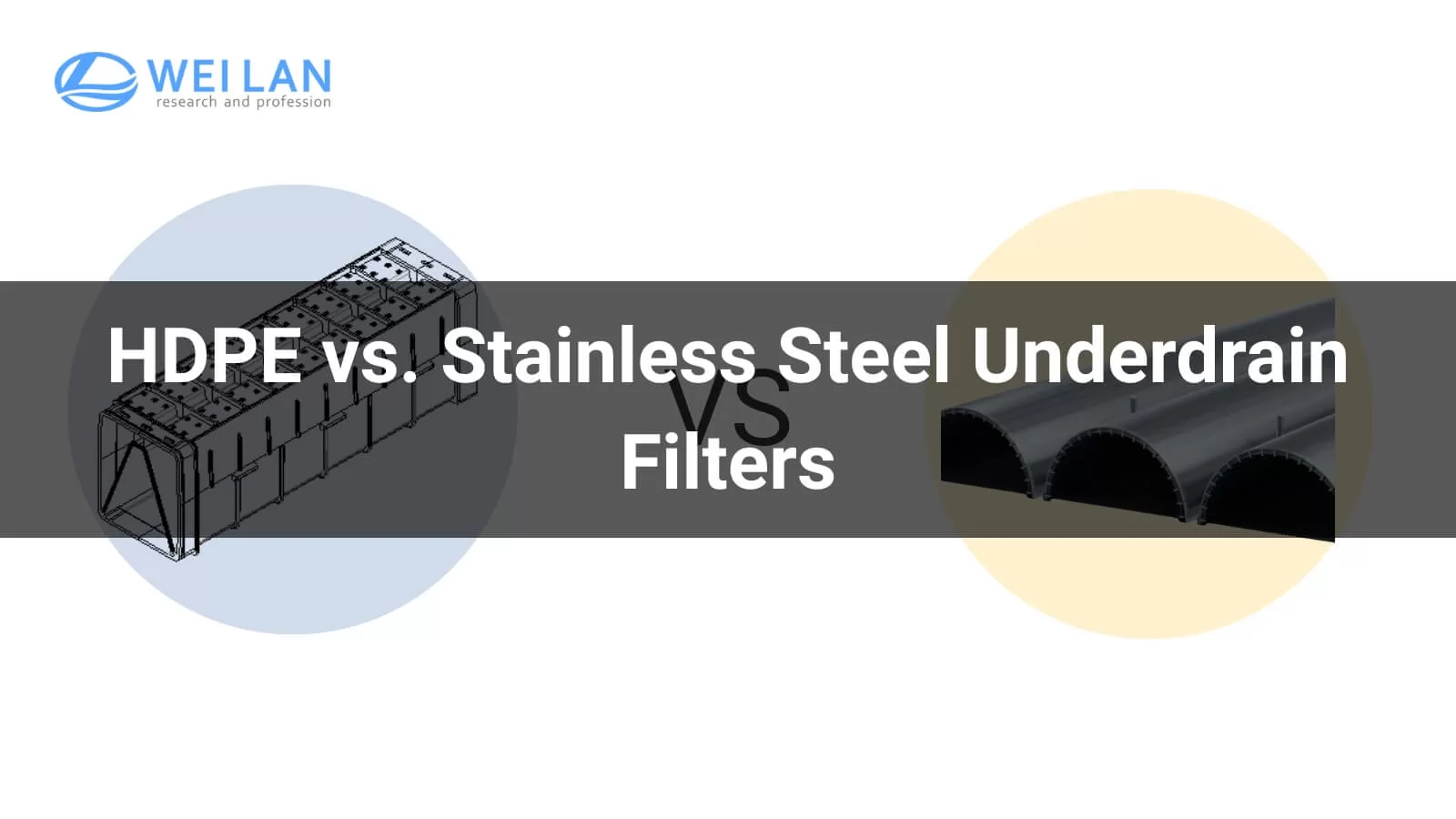
Selecting the right underdrain filter is a critical decision for any water treatment system. With options like HDPE and stainless steel underdrain filters, each material offers unique advantages in strength, durability, corrosion resistance, and cost. Choosing the wrong type can lead to reduced efficiency, higher maintenance, or premature replacement.
In this article, we break down the key differences between HDPE and stainless steel underdrain filters, helping you quickly understand which option is best for your application—whether it’s municipal water, industrial systems, or challenging chemical environments. By the end, you’ll have a clear guide to make an informed, cost-effective choice.
| Comparison Item | HDPE Underdrain Filters | Stainless Steel Underdrain Filters |
| Material Type | High-density polyethylene (HDPE) | Stainless steel (304 / 316) |
| Mechanical Strength | Moderate strength, flexible structure | High strength, rigid structure |
| Corrosion Resistance | Excellent resistance to corrosion and chemicals | Very good, especially with 316 grade |
| Temperature Resistance | Suitable for low to medium temperatures | Suitable for high-temperature applications |
| Weight | Lightweight, easy to handle | Heavier than HDPE |
| Installation | Easy installation, often modular design | More complex installation |
| Maintenance | Low maintenance requirements | Requires periodic inspection |
| Service Life | Long service life under normal conditions | Very long service life in harsh conditions |
| Typical Applications | Municipal water treatment, filters, softeners | Industrial water treatment, high-load systems |
| Initial Cost | Lower initial cost | Higher initial cost |
| Lifecycle Cost | Cost-effective for standard applications | Cost-effective for demanding environments |
HDPE underdrain filters offer moderate mechanical strength with good flexibility, allowing them to absorb stress during filtration and backwashing without cracking. They are highly resistant to corrosion and chemicals, making them durable in most municipal and standard water treatment applications. However, HDPE has lower load-bearing capacity and temperature resistance compared to metal systems.
Stainless steel underdrain filters provide high mechanical strength and rigidity, enabling them to withstand heavy media loads, high pressure, and strong backwash forces. Grades such as 304 and 316 deliver excellent durability, with 316 offering improved corrosion resistance in harsh environments. Stainless steel systems are well suited for industrial and high-demand applications.
HDPE underdrain filters are durable and cost-effective for normal operating conditions, while stainless steel underdrain filters offer superior strength and long-term reliability for demanding and high-load systems.
HDPE underdrain filters provide excellent resistance to corrosion and a wide range of chemicals. As a non-metallic material, HDPE does not rust, scale, or suffer from electrochemical corrosion, making it well suited for aggressive water conditions, chemical dosing systems, and wastewater treatment applications.
Stainless steel underdrain filters also offer strong corrosion resistance, particularly when manufactured from 316 stainless steel. They perform well in most water treatment environments but can be affected by chloride-rich or highly acidic conditions if the material grade is not properly selected.
HDPE underdrain filters excel in corrosion and chemical resistance across diverse water qualities, while stainless steel underdrain filters provide reliable resistance when the appropriate grade is used for the application.
HDPE underdrain filters are typically designed with precision-molded nozzles or blocks that provide uniform flow distribution across the filter bed. Their smooth internal surfaces help reduce head loss and support stable filtration and backwashing performance in standard water treatment systems.
Stainless steel underdrain filters offer high structural precision and excellent flow control, even under high flow rates and pressure. Their rigid construction ensures consistent slot geometry, making them suitable for heavy filter media and high-performance filtration applications.
HDPE underdrain filters deliver reliable and uniform flow distribution for most applications, while stainless steel underdrain filters provide superior performance in high-flow, high-load, and demanding filtration systems.
HDPE underdrain filters are lightweight and modular, allowing for faster installation with minimal lifting equipment. Their simple connection methods reduce installation time and labor costs. Maintenance requirements are low, as HDPE is resistant to corrosion and scaling.
Stainless steel underdrain filters are heavier and require more precise installation, often involving mechanical fixing or welding. Maintenance may include periodic inspection for wear or corrosion, especially in demanding operating conditions.
HDPE underdrain filters are easier to install and maintain, while stainless steel underdrain filters require more careful installation but offer long-term reliability in high-demand systems.
HDPE underdrain filters offer a long service life under normal operating conditions due to their resistance to corrosion, chemicals, and fatigue. They maintain stable performance in municipal and conventional water treatment systems when design loads and temperatures are properly controlled.
Stainless steel underdrain filters provide exceptional long-term reliability, especially in high-load and high-temperature environments. Their strong structural integrity and wear resistance allow them to perform consistently over extended service periods, particularly when 316 stainless steel is used.
HDPE underdrain filters deliver reliable long-term performance for standard applications, while stainless steel underdrain filters offer maximum durability and reliability for demanding and industrial systems.
Initial Purchase Cost:
HDPE underdrain filters generally have a lower upfront cost due to less expensive raw materials and simpler manufacturing processes. This makes them an attractive option for standard municipal and commercial water treatment installations.
Stainless steel underdrain filters typically involve higher material and fabrication costs, especially with premium grades like 316 stainless steel. This increases the initial investment but can be justified for demanding applications requiring higher strength and corrosion resistance.
Installation Cost:
HDPE systems are lighter and easier to install, reducing labor, equipment, and downtime expenses. Stainless steel systems are heavier and often require more precise installation, which can increase labor and handling costs.
Lifecycle Cost:
Over the long term, HDPE underdrains can be cost-effective for most standard uses due to low maintenance and corrosion resistance. However, in harsh environments or high-load systems, stainless steel underdrains may offer better value through extended service life and reduced replacement frequency, potentially lowering total lifecycle costs despite higher upfront expenses.
Choosing between HDPE and stainless steel underdrain filters depends on project requirements, operating conditions, and budget. Here’s a concise guide to help determine the best fit:
Best choice: HDPE
HDPE underdrain filters are cost-effective, corrosion-resistant, and reliable for typical municipal filtration systems. Their ease of installation and low maintenance make them ideal for standard water treatment plants.
Best choice: HDPE (standard), Stainless Steel (high demand)
For general tertiary filtration and wastewater systems, HDPE performs well. However, if the system faces high backwash forces or abrasive media, stainless steel may offer better long-term durability.
Best choice: Stainless Steel
Industrial applications often require high mechanical strength, temperature resistance, and longevity under stress. Stainless steel underdrains, especially 316-grade, excel in these conditions and deliver consistent performance.
Best choice: Stainless Steel (316)
When water chemistry or operating temperatures are extreme, 316 stainless steel provides superior resistance and structural stability.
Both HDPE and stainless steel underdrain filters have distinct advantages. HDPE is lightweight, corrosion-resistant, and cost-effective, making it ideal for standard municipal and commercial water treatment systems. Stainless steel offers superior strength, durability, and long-term reliability, making it the best choice for high-load, high-temperature, or industrial applications.
For those seeking high-quality underdrain filters and professional water treatment solutions, Weilan provides a full range of HDPE and stainless steel systems, combining reliable performance, long service life, and excellent customer support. Choosing Weilan ensures your filtration system operates efficiently and sustainably over the long term.


Your Name*
Your Email*

Discover the 5 most critical applications of underdrain filters in water treatment. From gravity filters to wastewater reuse, learn how these systems optimize filtration efficiency.

The article explains the operation of underdrain filters, covering filtration rates, backwashing steps, media settling, routine inspections, and basic troubleshooting tips.

Explore 2026 underdrain filter prices by type, material, and system size. Compare cost ranges, key factors, FAQs, and learn how to choose the right underdrain solution.