
+81 80 4673 6061
info@weilanwaters.com
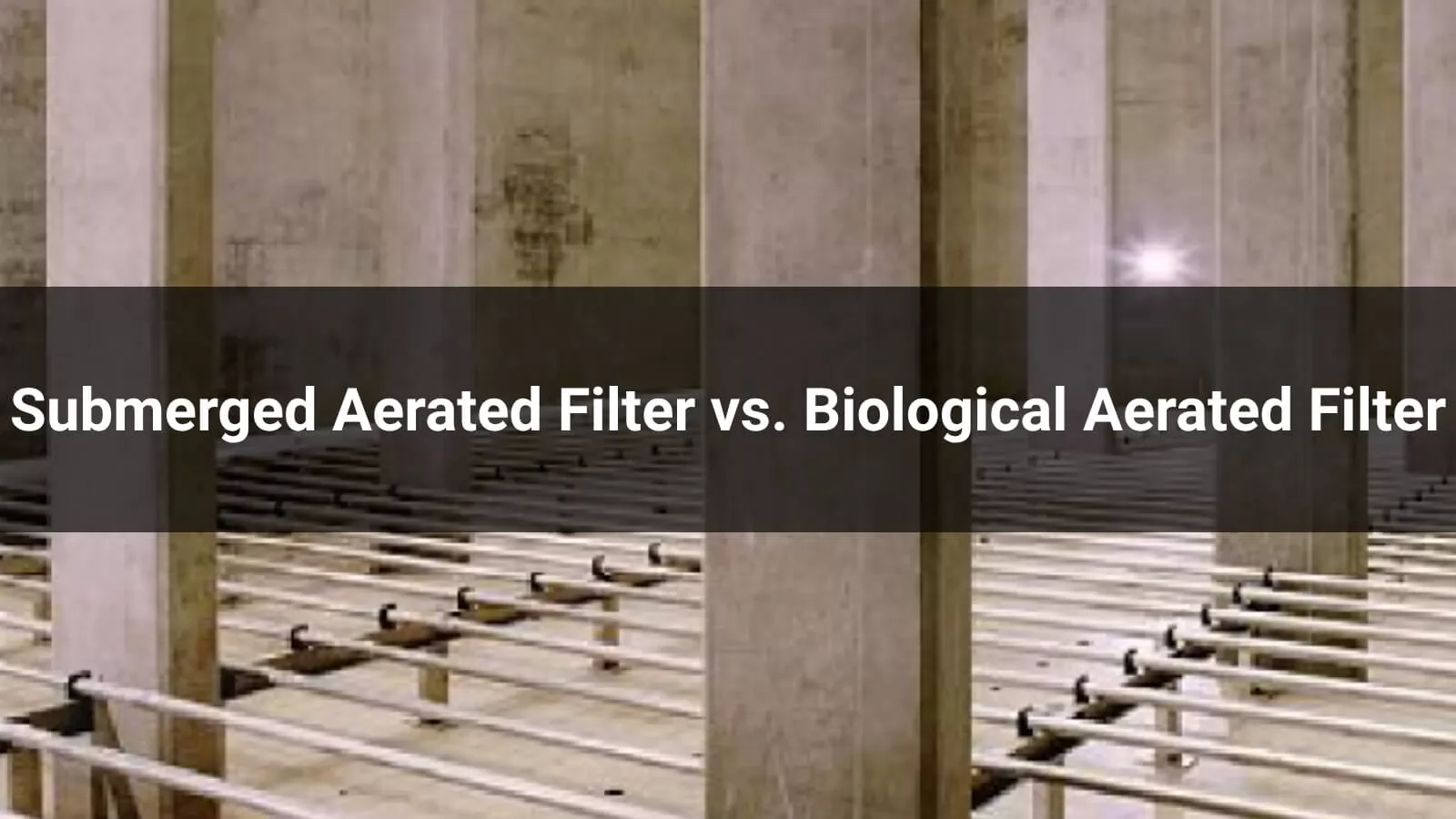
If you're designing or upgrading a wastewater treatment plant, the choice between a Submerged Aerated Filter (SAF) and a Biological Aerated Filter (BAF) can make or break your project's performance, footprint, and long-term operating costs. The two technologies sound similar — both rely on aerated biofilm processes — but their differences in design and performance lead to very different outcomes in real-world applications. Whether you're a project engineer, plant operator, or municipal decision-maker, this guide breaks down the key differences between SAF and BAF, so you can confidently select the right system for your next project.
Before diving into technical specifics, the table below summarizes the most important distinctions between SAF and BAF systems. Use this as a quick reference when comparing the two technologies:
| Parameter | Submerged Aerated Filter (SAF) | Biological Aerated Filter (BAF) |
| Working Principle | Fixed-film biofilm on submerged media in an aerated tank; no filtration function | Combined biological treatment + physical filtration in a single unit |
| Filter Media | Typically plastic or structured media; media remains stationary and fully submerged | Granular media (ceramic particles, volcanic rock, or specialized bio-balls) |
| Flow Direction | Generally horizontal or vertical with no strict filtration direction | Upflow or downflow with directional media bed filtration |
| Aeration Method | Coarse or fine bubble diffusers beneath the media zone | Fine bubble diffusion integrated with filtration layer |
| Effluent Quality | Requires downstream clarifier or separation step | Produces high-quality effluent directly; no secondary clarifier needed |
| Suspended Solids Removal | Limited — requires secondary settling | Excellent — removes SS within the same unit |
| Footprint | Larger — needs additional clarification stage | Compact — integrated process saves 30–50% space |
| Backwashing | Not required for media cleaning | Periodic backwash required (air + water scour) |
| Energy Consumption | Moderate | Moderate to higher (due to backwashing cycles) |
| Typical Applications | Small-to-medium municipal plants, decentralized treatment, industrial pretreatment | Municipal sewage plants, tertiary treatment, upgrades requiring compact footprint |
| BOD / Ammonia Removal | Effective, but performance depends on downstream processes | Highly effective with simultaneous nitrification |
The type of media used is the most fundamental difference between SAF and BAF systems, and it directly influences every other performance characteristic.
Submerged Aerated Filters typically use structured plastic media, honeycomb modules, or suspended packing materials that remain fully submerged in the aeration tank. The media provides a large surface area for microbial biofilm to grow, but it does not act as a physical filter — its sole purpose is to support biological activity.
Biological Aerated Filters, by contrast, use granular media such as ceramic particles, volcanic rock, or specialized bio-balls. This media performs two functions simultaneously: it hosts the biofilm that breaks down organic pollutants, and it physically traps suspended solids as wastewater passes through the bed. This dual-function design is what makes BAF systems uniquely compact and efficient.
SAF systems operate with relatively flexible flow patterns. Wastewater typically moves through the tank horizontally or with mild vertical circulation driven by aeration, with no strict directional filtration requirement.
BAF systems use a highly engineered upflow or downflow configuration. In an upflow BAF, wastewater enters from the bottom and rises through the granular media bed while air is introduced simultaneously — creating a counter-current contact zone that maximizes oxygen transfer and pollutant removal. This directional flow is also what enables the integrated filtration function.
Both systems rely on aeration to sustain aerobic microbial activity, but they achieve it differently.
SAF systems generally use coarse or fine bubble diffusers positioned beneath the media zone, providing straightforward oxygen supply for the biofilm. BAF systems use fine bubble diffusion integrated directly within the filtration layer, which typically delivers higher oxygen transfer efficiency (OTE) — often in the range of 15–25% higher than conventional submerged aeration — due to the extended contact time between air bubbles and the media bed.
Higher OTE translates directly into lower energy consumption per kilogram of BOD removed, which is a major factor in lifecycle cost calculations.
Performance is where the two technologies often surprise engineers evaluating them for the first time.
One of the operational differences most often overlooked is backwashing.
SAF systems do not require backwashing because the media doesn't clog — biofilm naturally sloughs off and is carried to a downstream clarifier. This simplifies daily operation but shifts the solids-handling burden to secondary treatment stages.
BAF systems require periodic backwashing — typically every 24 to 48 hours, depending on influent loading. The backwash cycle combines air scour and water flush to dislodge accumulated solids and excess biofilm. While this adds operational complexity, modern BAF systems like those equipped with Weilan's monolithic filter underdrain technology automate the process and ensure uniform distribution, minimizing operator intervention.
Footprint is often the deciding factor in retrofit projects or sites with limited land availability.
Because SAF systems rely on downstream clarifiers to separate solids from effluent, the total treatment train requires significantly more space. BAF systems integrate biological treatment and solids separation into a single unit, reducing the overall footprint by 30–50% compared to an equivalent SAF-plus-clarifier configuration.
For urban wastewater treatment plants, plant upgrades, or industrial sites where space is at a premium, this compactness is a major advantage — and it's one of the reasons BAF technology has become the preferred choice for modern municipal treatment plant upgrades in China, Europe, and Southeast Asia.
Energy use depends on more than just aeration — it includes pumping, backwashing, and sludge handling across the entire treatment train.
SAF operating cost profile:
BAF operating cost profile:
When evaluated on a total lifecycle cost basis, BAF systems typically deliver 10–20% lower operating costs for plants treating more than 5,000 m³/day, while SAF systems may be more economical for smaller, decentralized applications.
SAF systems are mechanically simpler, with fewer moving parts and no automated backwashing sequences. This makes them attractive for remote sites, small communities, or operators without specialized training.
BAF systems are more sophisticated, requiring automated backwash controls, air scour systems, and precise media distribution. However, once commissioned, they offer stable, hands-off operation with minimal daily attention. Weilan's BAF systems are engineered with this balance in mind — combining advanced process controls with rugged construction to minimize maintenance demands, as reflected in our 7 key pros and cons of biological aerated filters.
Choosing between a Submerged Aerated Filter and a Biological Aerated Filter isn't a matter of one technology being universally "better" — it's about matching the right solution to your project's specific requirements. The following selection framework helps project engineers, consultants, and plant operators evaluate which system best fits their needs based on five critical decision factors.
A Submerged Aerated Filter is typically the better choice when your project prioritizes simplicity, lower upfront investment, and flexibility in treatment configuration. Consider SAF if:
SAF systems shine in applications where the treatment train already includes clarification or where the operator prefers a low-maintenance biological stage with predictable performance.
A Biological Aerated Filter is the preferred choice for projects that demand high effluent quality, compact footprint, and long-term operational efficiency. Choose BAF if:
BAF technology is particularly well-suited for modern municipal wastewater treatment plants, industrial effluent treatment in sectors like food processing and petrochemicals, and upgrades of existing plants that must meet tighter discharge regulations without expanding their land footprint.
Different industries have distinct treatment challenges. Here's how SAF and BAF compare across common sectors:
Municipal Wastewater Treatment
BAF is generally preferred for medium-to-large municipal plants due to its compact footprint, strong ammonia removal, and integrated filtration. SAF may be suitable for small-town or village-scale applications where simpler operation outweighs space efficiency.
Industrial Wastewater (Food & Beverage, Pharmaceutical, Chemical)
For high-strength organic wastewater, BAF's superior BOD/COD removal and built-in solids retention make it the stronger candidate. SAF is often used as a pretreatment or polishing step in larger industrial treatment trains.
Tertiary Treatment and Water Reuse
BAF dominates this application because of its ability to deliver low-turbidity effluent suitable for reuse — for irrigation, industrial cooling, or non-potable urban uses — without a separate filtration stage.
Plant Upgrades and Retrofits
If existing aeration tanks can be converted with minimal civil work, SAF modules provide a cost-effective upgrade path. For plants facing new, stricter effluent limits, BAF offers a space-efficient way to meet compliance without major site expansion.
Decentralized and Remote Treatment
SAF's mechanical simplicity makes it well-suited for remote locations, while BAF is better for clustered community systems where capacity and effluent quality justify the added process control.
No. A BAF integrates biological treatment and solids filtration in a single unit, eliminating the need for a secondary clarifier. This is the key structural difference from SAF systems, which rely on downstream clarification to separate biomass from treated effluent — and it's the main reason BAF systems have a significantly smaller footprint.
It depends on scale. SAF systems typically have 15–25% lower capital costs and are more economical for small plants under 2,000 m³/day. BAF systems deliver lower total lifecycle costs for larger plants above 5,000 m³/day, thanks to reduced land requirements, no secondary clarifier, and lower long-term operating expenses.
Both systems achieve strong ammonia nitrogen removal through nitrification, with BAF generally delivering higher and more consistent performance. However, total nitrogen removal requires a downstream denitrification filter, and phosphorus removal typically requires chemical precipitation or a dedicated biological phosphorus removal process.
Choosing between a Submerged Aerated Filter and a Biological Aerated Filter comes down to your project's scale, effluent requirements, and site constraints. SAF offers a simpler, lower-cost solution ideal for small-scale plants and decentralized applications, while BAF delivers superior effluent quality, a compact footprint, and lower lifecycle costs for medium-to-large municipal and industrial projects. For plants facing strict discharge standards or limited land availability, BAF is typically the stronger long-term investment.
With over 15 years of experience and more than 200 completed projects, Weilan designs and manufactures high-performance water treatment systems tailored to your specific needs. Explore our Biological Aerated Filter solutions or contact our engineering team for a customized consultation and quotation.


Your Name*
Your Email*

Discover the 7 key pros and cons of biological aerated filters. Compare BAF to other wastewater treatment methods and find out if it's right for your facility.

Learn what is the process of denitrification in wastewater, its stages, bacteria, conditions, and benefits for efficient nitrogen removal and environmental protection.

Explore the 15 largest water treatment plants globally, including capacity, location, and key features that define today’s biggest and most influential water infrastructure projects.


